> For the complete documentation index, see [llms.txt](https://wiki.redmodding.org/cyberpunk-2077-modding/llms.txt). Markdown versions of documentation pages are available by appending `.md` to page URLs; this page is available as [Markdown](https://wiki.redmodding.org/cyberpunk-2077-modding/modding-guides/world-editing/archived-guides/adding-locations-and-structures-with-archivexl.md).
# Archived: Merging World Additions via ArchiveXL
This guide demonstrates how to add new locations to the world by creating new .streamingsector files and adding them to the game world by merging them with the all.streamingblock via ArchiveXL
{% hint style="danger" %}
This guide is outdated and should not be used anymore. For more recent information, see the [Object Spawner](https://github.com/justarandomguyintheinternet/CP77_entSpawner?tab=readme-ov-file#installation) GitHub page (Until the wiki article is updated)
{% endhint %}
**Valid as of March 21 2023**
Requirements
* [Wolvenkit 8.8.1](https://github.com/WolvenKit/WolvenKit/releases/tag/8.8.1) (bugs in nightlys and stable version 8.9.0 prevent adding new nodes to a streaming sector)
* [The latest stable release of ArchiveXL](https://github.com/psiberx/cp2077-archive-xl/releases) (thanks Psiberx!)
Resources
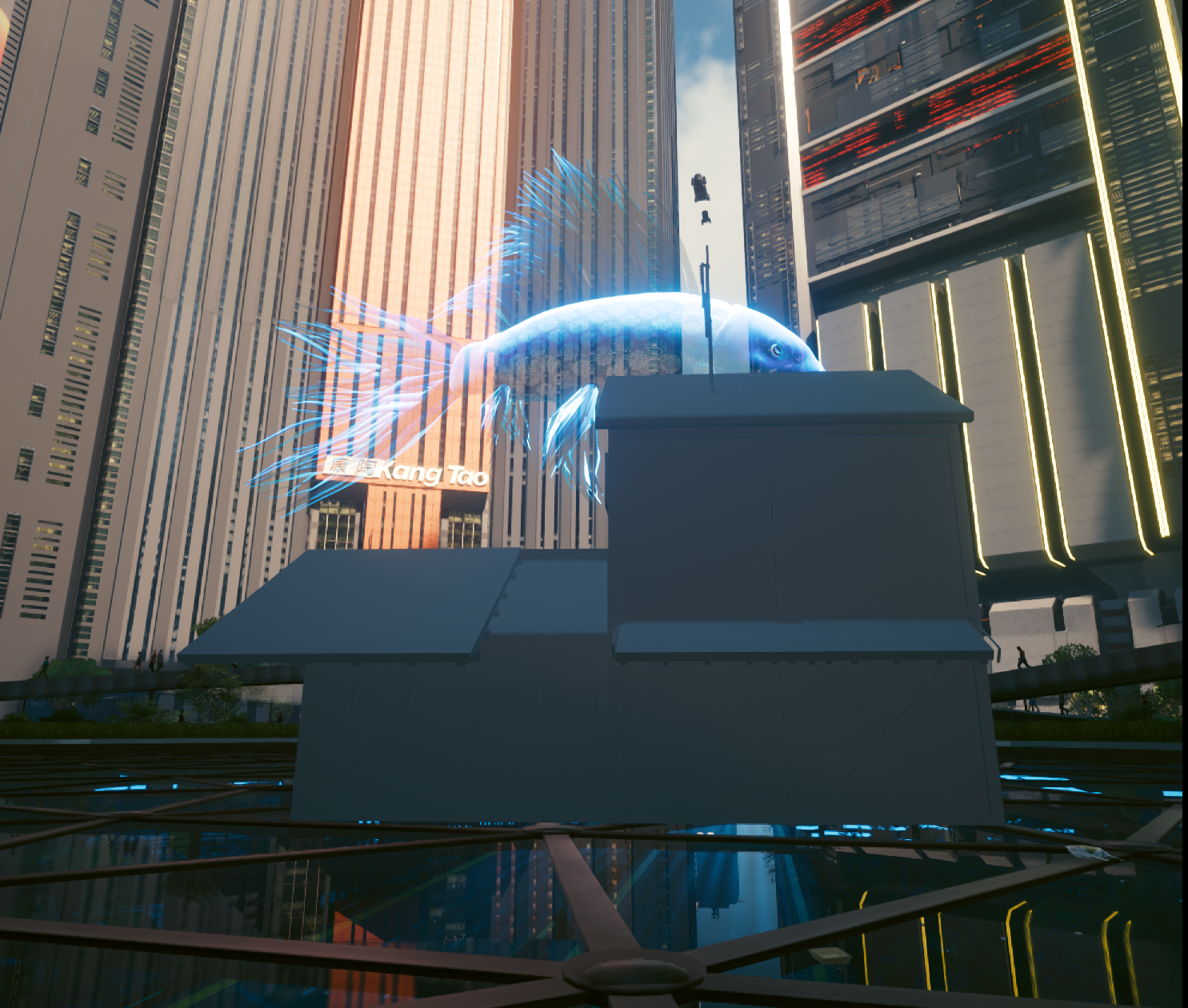
* [Example mod project, including template .XL file, .streamingsector and .streamingblock](https://mega.nz/file/LUFX1RhC#UWw91FcCmWa8bcBJYBGoDVgueYXp93zLLq3MjeCgQ9c) - this adds a low poly house exterior mesh to the center of the glass dome in corpo plaza (near the giant holo fish)
### Adding a custom location to a new streaming sector and merging it with the game world
* After following the previous guide to add and position the objects you want to add to the game, open the example mod project in Wolvenkit and open the file new\_mod\_sector.streamingsector
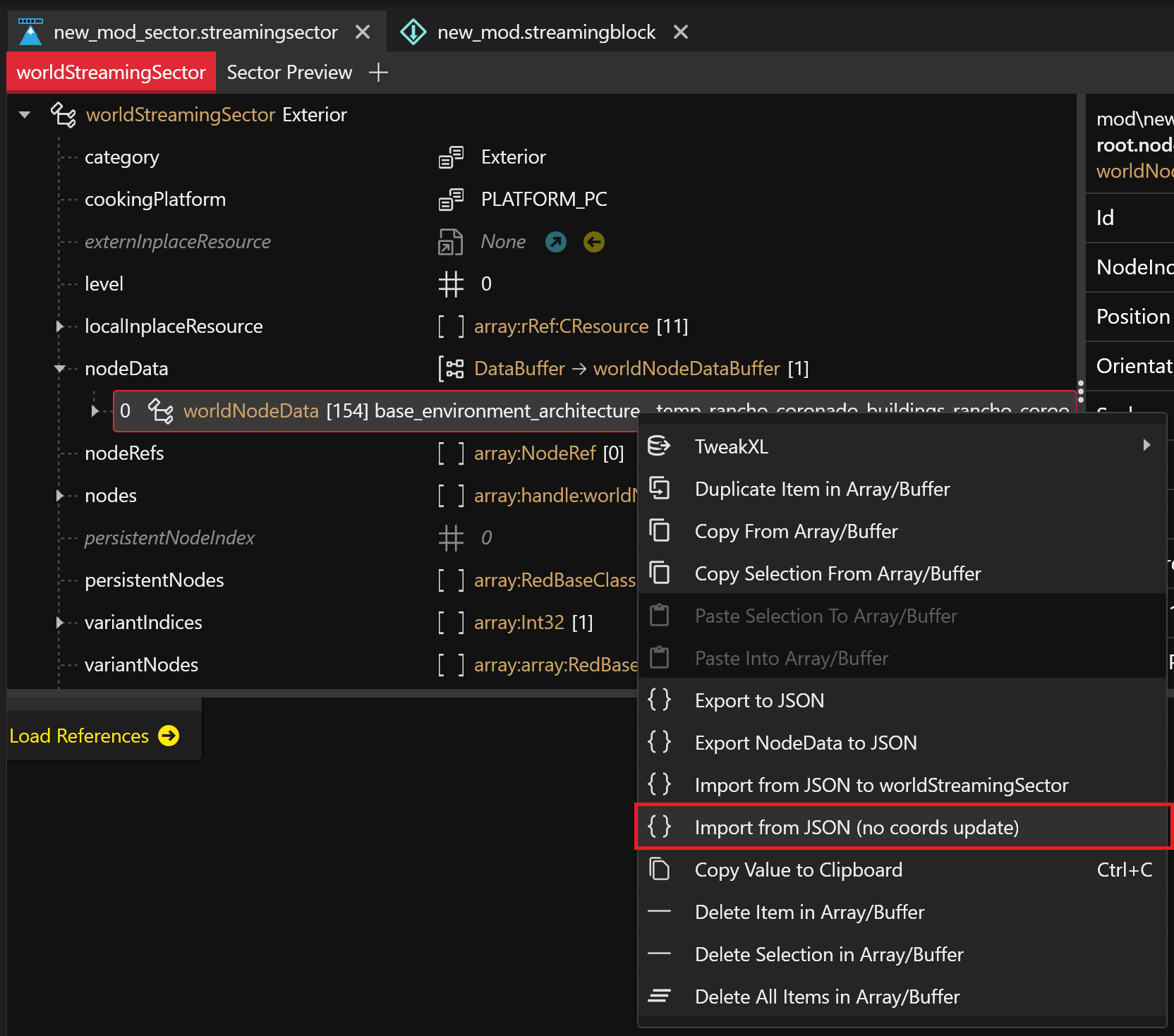
* in the "Node Data" section, right click on the existing node and click "Import from JSON (no coords update)
* This will open a window which allows you to browse to the export folder of Object Spawner. this will be something like `Cyberpunk 2077\bin\x64\plugins\cyber_engine_tweaks\mods\entSpawner\export` You will find a JSON file named after the main group you created and exported in this folder folder
* Select that file and Wolvenkit will create the necessary nodes, in the streaming sector, adding them to the location you selected.
* Delete the node which was included as an example and update the index of your node to 0 if it is not already.
* Rename the file to something unique for your mod.
* Open the new\_mod.streamingblock file in the project
* Under the "descriptors" tab, edit the 1st entry so that the depot path points to your .streamingsector file
*
```
```
* Now you need to set the streaming box for your new sector. The easiest way to figure this out is to just take the coordinates from a central object in your mod (you can find these in your .streamingsector file on each node) and add 300 units to each number for the max, subtract 300 for the min. This will need to be adjusted based on how far away you want your objects to be visible in the world.
* rename this streamingblock file to something unique to your mod
* Now all that's left is to edit the .xl file included in the resources section of the example so that it points to your streamingblock file. All you need to do is replace "mod\new\_mod.streamingblock" with the relative path to your streamingblock.
* Once you've done the above steps, install your new mod and launch the game, if you've completed all the steps, your new objects, structure or location will spawn just like the rest of the world
* If you run into any troubles, double check the guides and then pop over to #world-editing on the cyberpunk discord server
---
# Agent Instructions
This documentation is published with GitBook. GitBook is the documentation platform designed so that both humans and AI agents can read, navigate, and reason over technical content effectively. Learn more at gitbook.com.
## Querying This Documentation
If you need additional information that is not directly available in this page, you can query the documentation by asking a question.
Perform an HTTP GET request on the following URL with the `ask` and `goal` query parameters:
```
GET https://wiki.redmodding.org/cyberpunk-2077-modding/modding-guides/world-editing/archived-guides/adding-locations-and-structures-with-archivexl.md?ask=&goal=
```
`ask` is the immediate question: it should be specific, self-contained, and written in natural language.
`goal` is what the user is ultimately trying to achieve, the reason they need the answer. Sharing it helps GitBook give you a better, more relevant answer. A goal is most helpful when it describes the outcome the user wants rather than restating the question. For example, with `ask=how do I create an API token`, a goal like `automate deployments from our CI pipeline` lets GitBook tailor the answer to that use case.
The response will contain a direct answer to the question and relevant excerpts and sources from the documentation.
Use this mechanism when the answer is not explicitly present in the current page, you need clarification or additional context, or you want to retrieve related documentation sections.