> For the complete documentation index, see [llms.txt](https://wiki.redmodding.org/cyberpunk-2077-modding/llms.txt). Markdown versions of documentation pages are available by appending `.md` to page URLs; this page is available as [Markdown](https://wiki.redmodding.org/cyberpunk-2077-modding/for-mod-creators-theory/materials/configuring-materials/tinting-textures-in-wolvenkit.md).

# Tinting textures in Wolvenkit

How to colour your clothing item without adding extra textures

## Summary

**Created:** Jul 18 2025 by [mana vortex](mailto:undefined)\
**Last documented update:** Jul 18 2025 by [mana vortex](mailto:undefined)

This page will show you how to create colour variants of textured materials without recolouring textures.

## The problem

Who doesn't know it? You have a textured shirt, and you want to create multiple colour variants.

Most game engines "solve" this by including a different-coloured texture. This leads to huge mod files and [bad performance](/cyberpunk-2077-modding/for-mod-creators-theory/3d-modelling/on-4k-textures-and-high-poly-meshes.md#texture-resolution-and-visual-return) and thus, we do not like it.

Fortunately, Cyberpunk materials are smarter than this.

## The solution

Many shaders offer a parameter to **tint** textures on-the-fly by setting a material property:

As you can see, both materials are using the same textures — the tinting happens via `BaseColorScale` parameter. You can use that to avoid texture duplication.

See [#supporting-materials](#supporting-materials "mention") for a list.

### How to add the parameter

1. Select the material's **values** array
2. In the panel on the right, click the yellow + button
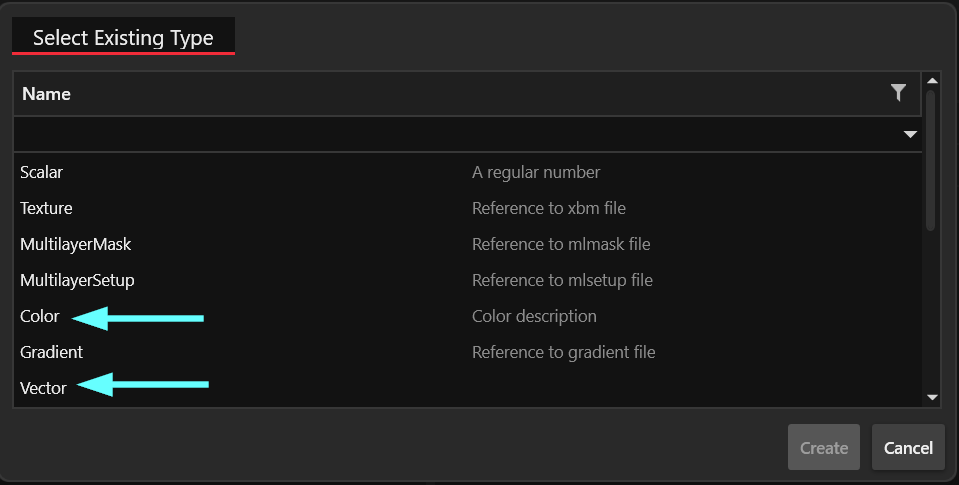
3. In the "Select Existing Type" popup, select Vector or Color

<figure><img src="https://1427525421-files.gitbook.io/~/files/v0/b/gitbook-x-prod.appspot.com/o/spaces%2F4gzcGtLrr90pVjAWVdTc%2Fuploads%2Fgit-blob-c45eea62c51ea907f7a058af2bc288604001b57a%2Ftinting_textures_create_parameter.png?alt=media" alt=""><figcaption></figcaption></figure>

4. If your parameter is a vector, **change its name** to `BaseColorScale` or `HSV_Mod`, then re-select the node in Wolvenkit to see the colour editor

## Supporting materials

### Paramter: BaseColorScale

<table><thead><tr><th width="530.3333740234375">Material</th><th>Parameter type</th></tr></thead><tbody><tr><td>cyberware_animation</td><td>Color</td></tr><tr><td>device_diode</td><td>Color</td></tr><tr><td>devide_diode_multi_state</td><td>Color</td></tr><tr><td>metal_base_alpha_animated</td><td>Vector</td></tr><tr><td>metal_base_atlas_animation</td><td>Color</td></tr><tr><td>metal_base_glitter</td><td>Color</td></tr><tr><td>blackwall_blendable_metal_base</td><td>Vector</td></tr><tr><td>3d_map_cubes</td><td>Color</td></tr><tr><td>3d_map_terrain</td><td>Color</td></tr><tr><td>cable</td><td>Vector</td></tr><tr><td>cloth_mov</td><td>Vector</td></tr><tr><td>cloth_tarps_pbr</td><td>Color</td></tr><tr><td>cloth_tarps_pbr_no_vat</td><td>Color</td></tr><tr><td>cloth_wind_proxy</td><td>Vector</td></tr><tr><td>decal_forward</td><td>Color</td></tr><tr><td>decal_terrain_projected</td><td>Vector</td></tr><tr><td>earth_globe</td><td>Color</td></tr><tr><td>emissive_control</td><td>Color</td></tr><tr><td>glass_cracked_edge</td><td>Vector</td></tr><tr><td>ice_ver_mov_translucent</td><td>Color</td></tr><tr><td>lights_interactive</td><td>Vector</td></tr><tr><td>metal_base_bink</td><td>Color</td></tr><tr><td>metal_base_det</td><td>Vector</td></tr><tr><td>metal_base_det_dithered</td><td>Vector</td></tr><tr><td>metal_base_dithered</td><td>Vector</td></tr><tr><td>metal_base_gradientmap_recolor</td><td>Vector</td></tr><tr><td>metal_:base_parallax</td><td>Vector</td></tr><tr><td>metal_base_trafficlight_proxy</td><td>Vector</td></tr><tr><td>neon_parallax</td><td>Vector</td></tr><tr><td>presimulated_particles</td><td>Color</td></tr><tr><td>proxy_ad</td><td>Color</td></tr><tr><td>q116_mikoshi_floor</td><td>Color</td></tr><tr><td>q202_lake_surface</td><td>Color</td></tr><tr><td>road_debug_grid</td><td>Color</td></tr><tr><td>speedtree_3d_v8_onesided_gradient_recolor</td><td>Vector</td></tr><tr><td>spline_deformed_metal_base</td><td>Color</td></tr><tr><td>vehicle_lights</td><td>Vector</td></tr><tr><td>ver_mov</td><td>Color</td></tr><tr><td>ver_skinned_mov</td><td>Color</td></tr><tr><td>ver_skinned_mov_parade</td><td>Color</td></tr><tr><td>windows_parallax_interior_proxy_buiffer</td><td>Color</td></tr><tr><td>window_very_long_distance</td><td>Color</td></tr><tr><td>worldspace_grid</td><td>Color</td></tr></tbody></table>

### Parameter: HSV\_Mod

<table><thead><tr><th width="529.3333129882812">Material name</th><th>Parameter type</th></tr></thead><tbody><tr><td>metal_base_blackbody</td><td>Vector</td></tr><tr><td>parallaxscreen</td><td>Vector</td></tr><tr><td>fx_mesh_decal__blackbody</td><td>Vector</td></tr></tbody></table>


---

# Agent Instructions
This documentation is published with GitBook. GitBook is the documentation platform designed so that both humans and AI agents can read, navigate, and reason over technical content effectively. Learn more at gitbook.com.

## Querying This Documentation
If you need additional information that is not directly available in this page, you can query the documentation by asking a question.

Perform an HTTP GET request on the following URL with the `ask` and `goal` query parameters:

```
GET https://wiki.redmodding.org/cyberpunk-2077-modding/for-mod-creators-theory/materials/configuring-materials/tinting-textures-in-wolvenkit.md?ask=<question>&goal=<user_goal>
```

`ask` is the immediate question: it should be specific, self-contained, and written in natural language.
`goal` is what the user is ultimately trying to achieve, the reason they need the answer. Sharing it helps GitBook give you a better, more relevant answer. A goal is most helpful when it describes the outcome the user wants rather than restating the question. For example, with `ask=how do I create an API token`, a goal like `automate deployments from our CI pipeline` lets GitBook tailor the answer to that use case.

The response will contain a direct answer to the question and relevant excerpts and sources from the documentation.

Use this mechanism when the answer is not explicitly present in the current page, you need clarification or additional context, or you want to retrieve related documentation sections.