| /pages/CWyKr6rSIAKmIOI4nFaA | Wiki: List of world sectors for e.g. V's apartment. |
| CET wiki | List of interesting locations for teleporting |
| AMM DIscord | An entire channel dedicated to locations |
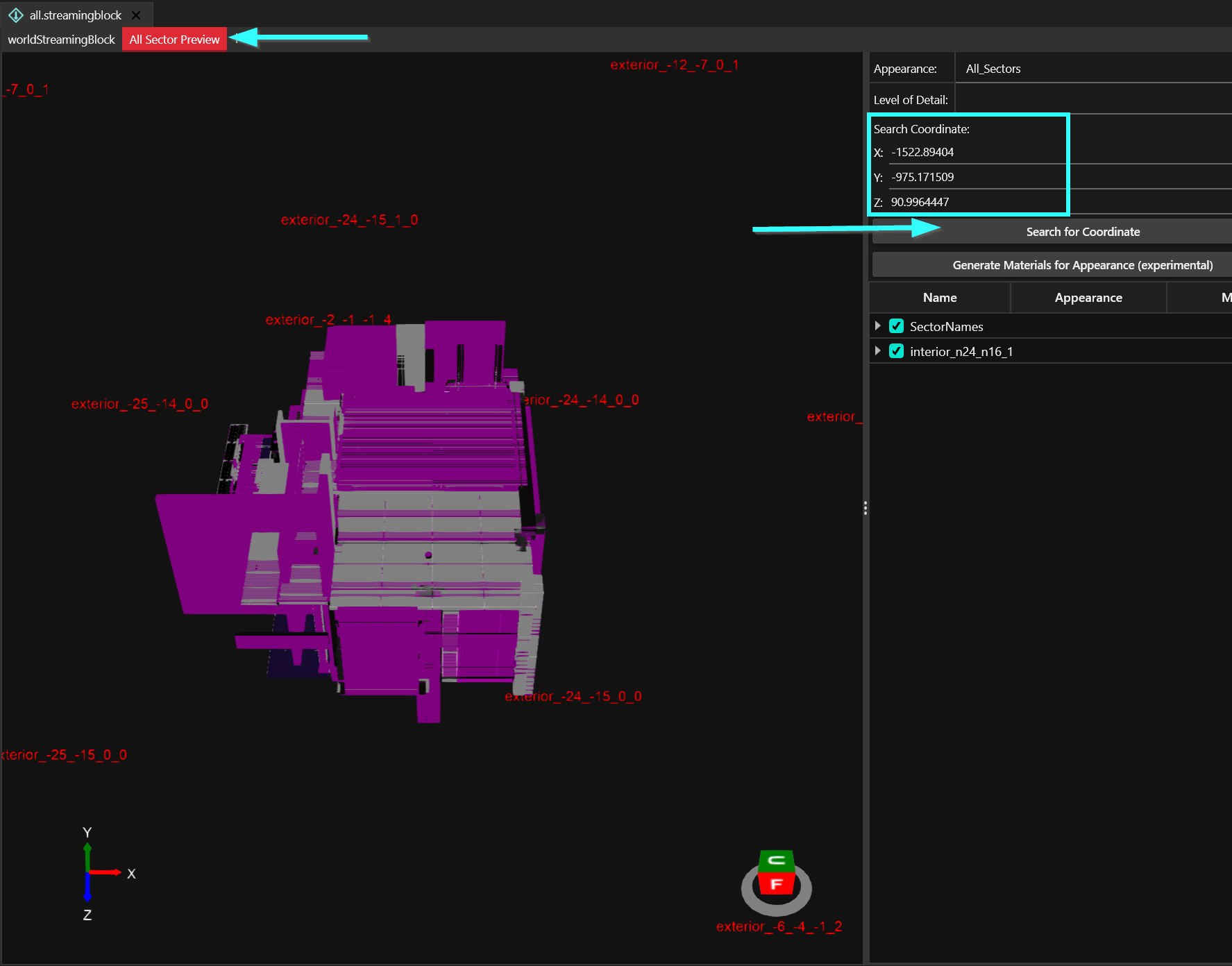 For details on how to find other LOD levels, check [here](https://wiki.redmodding.org/cyberpunk-2077-modding/modding-know-how/files-and-what-they-do/the-whole-world-.streamingsector#calculating-the-files).
**Method 2: Following the meshes**
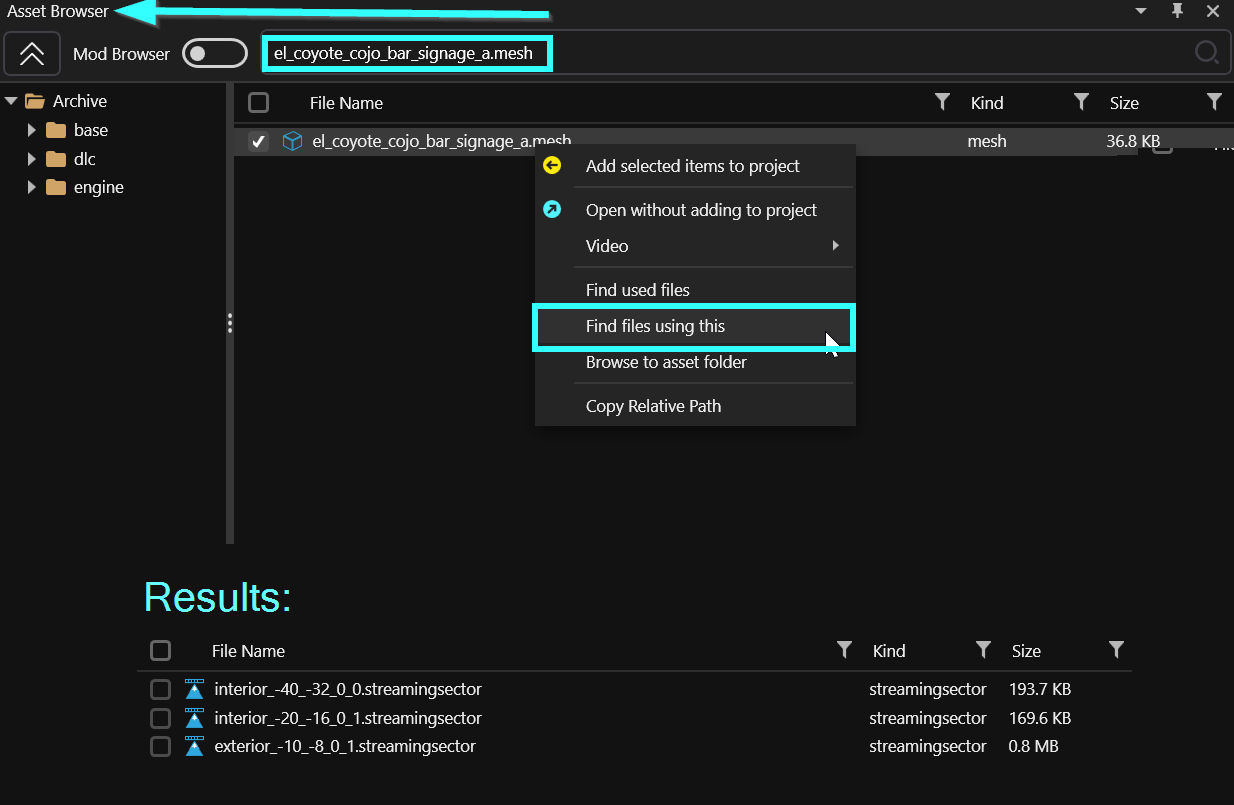
If you know a mesh that's used inside the location, you can right-click the mesh file inside Wolvenkit's asset browser and use "**Find files using this**".
You might want to consider using a unique mesh rather than a standard cup or bottle.
For details on how to find other LOD levels, check [here](https://wiki.redmodding.org/cyberpunk-2077-modding/modding-know-how/files-and-what-they-do/the-whole-world-.streamingsector#calculating-the-files).
**Method 2: Following the meshes**
If you know a mesh that's used inside the location, you can right-click the mesh file inside Wolvenkit's asset browser and use "**Find files using this**".
You might want to consider using a unique mesh rather than a standard cup or bottle.
 **Method 3: Via script**
Go [here for PL](https://colab.research.google.com/github/Simarilius-uk/sectorStuff/blob/main/AllBlocks_colab_w_streamingblock_PL.ipynb) ([old link](https://colab.research.google.com/github/Simarilius-uk/sectorStuff/blob/main/AllBlocks_colab_w_streamingblock.ipynb)) and either use the script in your webbrowser (recommended) or download the script locally to run it with Python.
**When running from browser:**
Change the x, y and z coordinate to the coordinates that you found[ via CET](#prerequisite-getting-the-coordinates):thumbsup:
**Method 3: Via script**
Go [here for PL](https://colab.research.google.com/github/Simarilius-uk/sectorStuff/blob/main/AllBlocks_colab_w_streamingblock_PL.ipynb) ([old link](https://colab.research.google.com/github/Simarilius-uk/sectorStuff/blob/main/AllBlocks_colab_w_streamingblock.ipynb)) and either use the script in your webbrowser (recommended) or download the script locally to run it with Python.
**When running from browser:**
Change the x, y and z coordinate to the coordinates that you found[ via CET](#prerequisite-getting-the-coordinates):thumbsup:
 **When running locally:**
The script requires you to have a local json export of `all.streamingblock` somewhere.
Change line 11 to the absolute path of your json (remember the double slashes):
```
11 filepath = 'C:\\CyberpunkModding\\Files\\all.streamingblock.json'
```
You'll find the coordinates in line 31. Change them to the coordinates that you found [via CET](#perquisite-getting-the-coordinates):
```
31 player_loc={'X':-1604.0522,'Y':353.99716,'Z':49.200005}
```
Now, run the script via Python. It'll give you a list of interior/exterior sector files together with the distance from your coordinates.
The blocks at the bottom can be used to generate a streamingblock json file for just the results, which can be imported to wolvenkit to preview them as per Method 1. if running the script locally you will need to download the sectors.streamingblock file from the github and edit the templatepath variable to point at it.
**When running locally:**
The script requires you to have a local json export of `all.streamingblock` somewhere.
Change line 11 to the absolute path of your json (remember the double slashes):
```
11 filepath = 'C:\\CyberpunkModding\\Files\\all.streamingblock.json'
```
You'll find the coordinates in line 31. Change them to the coordinates that you found [via CET](#perquisite-getting-the-coordinates):
```
31 player_loc={'X':-1604.0522,'Y':353.99716,'Z':49.200005}
```
Now, run the script via Python. It'll give you a list of interior/exterior sector files together with the distance from your coordinates.
The blocks at the bottom can be used to generate a streamingblock json file for just the results, which can be imported to wolvenkit to preview them as per Method 1. if running the script locally you will need to download the sectors.streamingblock file from the github and edit the templatepath variable to point at it.